
Multnomah Parole and Probation
A Multnomah County supervision check begins with the judgment. Probation is a court sentence that can let a person remain in the community without first serving a state-prison term. Post-prison supervision, often shortened to PPS, follows a determinate Oregon prison sentence. Parole is a conditional release structure tied mainly to particular offense dates and older or indeterminate sentences. Calling all three “parole” can send a records request to the wrong office.
The Multnomah County Department of Community Justice parole and probation entry point covers local community supervision. The Oregon Board of Parole and Post-Prison Supervision sets conditions and makes designated parole or PPS decisions. Local community corrections performs much of the daily work. Someone supervised in the community is generally outside jail or prison, but a later arrest, sanction, warrant, or revocation may change custody.
| Status | How it starts | Main verification source |
|---|---|---|
| Probation | Ordered by a court, sometimes with no prison term | Court judgment and Department of Community Justice |
| Post-prison supervision | Begins after a determinate ODOC prison term | ODOC record, court judgment, and local supervision office |
| Parole | Conditional release under applicable offense-date law | Board order and local supervision office |
- Discharge
- The formal end of a custody or supervision term.
- Absconder
- A person whom supervision authorities allege has stopped required contact.
- Revocation
- An official action ending or changing release after a violation process.
- Detainer
- A request or hold from another authority that can affect custody or release.
Check Multnomah Supervision Records
No single public name search resolves every Multnomah County parole and probation question. The county page provides the local route, while the court judgment shows whether probation or post-prison supervision was imposed. Board matters require the Board calendar or a written order. A current jail search answers custody, not supervision. The sequence below keeps those records in their proper roles.
- Find the criminal case through the Multnomah Circuit Court records channel and read the judgment for probation, prison, PPS, or parole terms.
- Use the Department of Community Justice contact path to confirm whether local supervision is active and to identify the correct office.
- For a Board matter, review the Oregon Board hearing calendar and the notice for the named hearing.
- Request the written Board order when the outcome matters. A calendar entry proves only that a hearing was scheduled.
- Check MCSO PAID or ODOC separately if present custody must be known. Never infer jail custody from a supervision violation alone.
The full Multnomah County released inmate search and record path explains how county release data, Oregon Offender Search, court records, and agency requests fit together. For parole or probation, the court and supervision records carry more weight than a convenience roster.
Note: A supervision record and a custody record answer different questions and should be checked separately.
Multnomah Supervision Agency Contacts
The Department of Community Justice is the local supervision agency. The research identifies its county parole and probation page as the public entry point but does not supply one universal office address, phone number, or set of hours for every unit. That matters because assignments and programs differ. Use the county page to reach the current unit rather than relying on an old directory entry.
Community supervision for probation, parole, and post-prison supervision
Open the county parole and probation directory
For a Board record, use the Board records-request channel. Requests may be emailed to ParoleBoardRecords@paroleboard.oregon.gov, mailed to Records Requests, BOPPPS, 1321 Tandem Avenue NE, Salem, OR 97301, or faxed to 503-373-7558. The Board says most adult-in-custody records are retained for 25 years and most Board records for ten years. Retention does not mean every part is public.
Multnomah Parole Hearing Outcomes
Oregon’s Board calendar is an embedded live schedule. It is not a completed-decisions database. No fixed weekly or monthly posting cadence is promised, and each public notice controls its own date, location, and access terms. Since May 7, 2025, the Board states that relevant hearings occur in person inside ODOC at Oregon State Penitentiary or Oregon State Correctional Institution, subject to advance clearance and the specific notice. Questions about public or victim attendance can be directed to the victims specialist at 503-945-0907 or hearings specialist at 971-718-6163.
The hearing type shapes the result. A Prison Term hearing may set or decline to set a projected parole date. An Exit Interview may affirm or defer that date after review of a release plan, reports, and conduct. Personal Review, Parole Consideration, Murder Review, Parole Postponement, older-system parole proceedings, and Future Disposition after revocation each apply different tests. A result should not be reduced to “granted” or “denied” when the written order uses a more exact outcome.
ORS 144.135 requires detailed written bases for Board decisions. ORS 144.120 and 144.125 govern hearing timing and prerelease review for applicable parole cases. Eligibility depends on the sentence and offense date. Most post-1989 guideline cases use a determinate prison term followed by PPS, not universal discretionary parole.
The official Board hearings page shows the calendar and explains the types of proceedings used in Oregon.
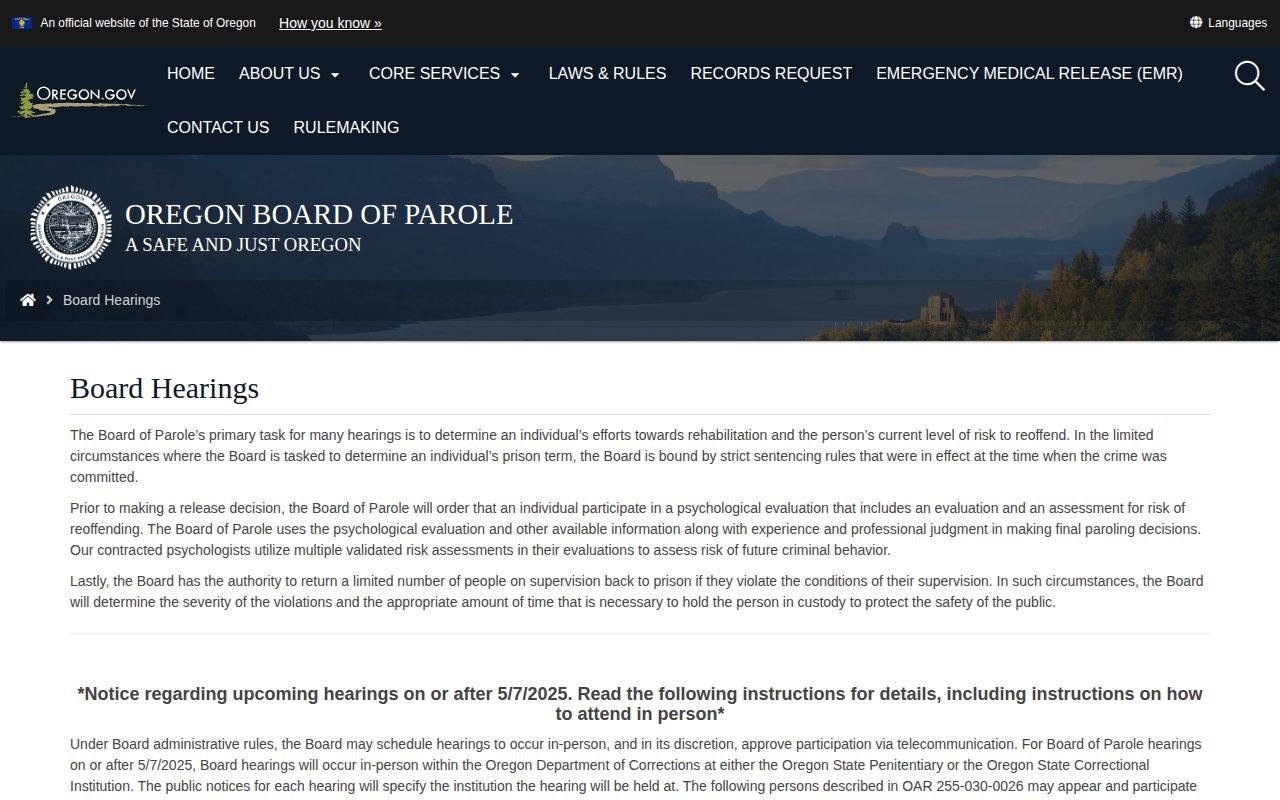
The captured calendar supports checking the notice for a pending event. It does not replace the later written order. When a Multnomah County parole result must be verified, request that order by person, hearing type, and date range. This keeps a projected event distinct from the Board's final action and prevents a calendar entry from being read as a release decision.
Multnomah Supervision Violation Checks
An alleged violation means authorities claim a condition was not met. Absconding usually means alleged loss of contact. Neither term states where the person is now. A violation can lead to added conditions, a sanction, a warrant, arrest, or a revocation process, but those later steps need their own records. Verify a warrant with the issuing authority and verify custody through MCSO or ODOC.
Conditions are set by the judgment, Board order, and supervising authority. They can include reporting duties and other case-specific requirements. A public summary should not be treated as the full order. If the question is whether supervision ended, request the discharge entry or final order. “Released from jail” and “discharged from supervision” are not the same event.
Multnomah Release Transition Support
Multnomah County has a local transition layer that can overlap with post-release supervision. ARC Transition Services may start planning up to 120 days before a prison or jail release and continue for 90 to 180 days after return. The documented purpose-neutral help includes case coordination, transportation, medical or benefit appointments, and family or friend orientations. It is especially relevant for people returning from state prison to Multnomah County.
ARC is not proof of parole, probation, or PPS. Participation also does not prove that a person is out of custody on a given day. It is a continuity service. The sentence, release record, and supervision agency remain the sources for legal status. For direct contact, the county lists 503-988-3081, then press 0 and ask for ARC.
Note: ARC support may cross the release date, but legal supervision status still comes from the court and corrections agencies.
Property After Multnomah Release
Property rules depend on which custody system released the person. MCSO’s county-jail rule is all-or-nothing. The adult in custody must authorize release of all stored personal property to a named recipient before pickup. Staff will not start the form merely because an outside person asks. That authorization is separate from probation or parole records.
State-prison discharge has a different framework. ORS 421.125 requires ODOC at discharge or parole to address proper clothing, safeguard and disburse adult-in-custody funds, and provide certifications for completed institutional programs. Those state duties should not be imported into an MCSO property pickup. The custody source determines the process.
Multnomah Supervision Discharge Records
Supervision ends through a formal discharge, expiration, court action, or Board action that fits the case. The best record depends on the sentence. A probation discharge is usually grounded in the court record. A parole or PPS matter may require an ODOC record, a Board order, and the local supervision entry. When exact proof is needed, ask for the named discharge document instead of a broad “all records” request.
Oregon Public Records Law permits written requests that identify records with enough detail. A Board request should include the person’s full name, SID if known, the type of decision, and a useful date range. Some information may be withheld or redacted. A retained record is not automatically open in full, yet reasonably segregable nonexempt material must be disclosed under ORS 192.338.
A final discharge means the supervision term ended. It does not erase the underlying judgment or every agency record. A later set-aside has its own legal effect and record path. Keep release, supervision discharge, and court record status separate.