
Multnomah Projected Versus Actual Release
MCSO PAID was directly observed using the exact field label “Projected Release Date” on a county booking detail. The same detail can show the actual Release Date and Release Reason after custody ends. These fields answer different questions. The projection is the date calculated from current information. The actual entry records what the agency says happened. Neither should be substituted for the other.
A pretrial detainee may have no fixed projected date. That person has not yet begun a definite sentence, and release may depend on a judge, recognizance, bail, pretrial supervision, dismissal, or another custody authority. A sentenced person may have a calculated date, but it can still move. A transfer out of MCDC also is not proof of release to the community.
- Projected release date
- A working date based on the sentence and credits known to the agency.
- Actual release date
- The date the custody record reports that the person left that authority.
- Pretrial credit
- Credit a court or agency applies for qualifying time held before sentence.
- Concurrent sentence
- A sentence served at the same time as another sentence.
- Consecutive sentence
- A sentence that runs after another term rather than at the same time.
Find Multnomah Inmate Release Dates
The correct lookup turns on the holder of the record. MCDC and Inverness use the MCSO booking system. Columbia River Correctional Institution is an ODOC state prison and follows the state route. A court judgment sets legal terms, but the court may not record the exact physical exit. This sequence separates those sources.
- Identify whether the person is in Multnomah County jail, an Oregon state prison, federal custody, or another authority.
- For a county booking, use MCSO PAID. Open the correct booking and read the Projected Release Date field only if it is present.
- For a county release already completed within seven days, choose “Released Last 7 Days” and read the actual Release Date and Release Reason.
- For an ODOC case, use Oregon Offender Search as a locator. Do not claim an exact projected-date field label unless the current result displays it.
- Read the court judgment for sentence length, custody term, probation, or post-prison supervision.
- Request the jail or ODOC record when certified or durable proof is needed.
OOS is periodically updated and is not an official record. The current live portal and disclaimer were verified, but the research did not capture a suitable released result showing the exact state projected-date label. It would be inaccurate to import MCSO’s county field name into OOS or to promise that every ODOC public record displays a date.
Note: A county-jail-only detainee may not appear in Oregon Offender Search because ODOC did not hold that custody episode.
Multnomah Jail Release Credits
Oregon has a distinct credit framework for a definite county-jail sentence. ORS 169.110 authorizes discretionary good-behavior deductions by sentence band. The schedule is not a flat percentage. ORS 169.120 separately permits locally set work credits and sets statutory caps. These county provisions should not be described as ODOC’s earned-time program.
| Definite county sentence | ORS 169.110 deduction scale |
|---|---|
| 10 to 30 days | One day per ten days |
| More than 30 through 90 days | Three days per 30 days |
| More than 90 through 180 days | Four days per 30 days |
| More than 180 through 270 days | Five days per 30 days |
| More than 270 days | Six days per 30 days |
Work credit under ORS 169.120 can be set locally, with a cap of ten days per 30 days. For a 10-to-30-day sentence, the statutory rate is one day per ten. Alternative-sentencing-facility credit requires county authorization. Eligibility and awards must be confirmed from the actual jail and sentence record. A public projection may reflect current credits without explaining each calculation.
Oregon State Release Calculations
ODOC earned time uses a separate state-prison rule. ORS 421.121 applies to eligible felonies committed on or after November 1, 1989. The statute lists exclusions, including sentences under ORS 137.635, 137.700, 137.707, 163.105, 163.107, and 163.115. Credits depend on suitable institutional behavior and adult-basic-skills participation under the law and ODOC rules.
The maximum eligible reduction is 20 percent of the DOC incarceration term, and the statute does not allow actual confinement below six months. ODOC rules govern grant, retraction, and restoration. “Up to” is key. The full amount is not automatic, and the public date can change if credit status changes.
Oregon should not be described as having a broad rule that everyone serves about 85 percent. Measure 11 under ORS 137.700 is stricter: a listed mandatory minimum is served in full, without an ORS 421.121 reduction during that minimum. ORS 137.712 allows limited departure exceptions, and a sentence imposed under that section can be credit-eligible. The sentence and offense statute control.
Why Multnomah Release Dates Change
A date is calculated from a stack of records rather than one field. The court supplies the sentence. Corrections applies the start date, credit rules, sentence relationships, and later changes. Another authority may lodge a hold. An appellate or amended order can alter the legal base. Even a correct public date can lag the operative record.
| Factor | Possible effect |
|---|---|
| Sentence start and pretrial credit | Changes the time already counted toward the term |
| Concurrent or consecutive treatment | Changes whether terms overlap or run in sequence |
| Earned, behavior, or work credit | May reduce an eligible county or state term |
| Misconduct or retraction | Can remove credits or move a date later |
| Warrant, detainer, or hold | May keep the person in custody or cause transfer to another authority |
| Appeal or amended court order | Can change the legal sentence or credit basis |
| Parole or Board action | May set, affirm, defer, postpone, or otherwise affect a date in an applicable case |
| Administrative correction | Fixes data or calculation errors in the agency record |
A detainer is a hold or request from another authority. It can mean the person leaves one facility but enters another agency’s custody. Likewise, a supervision violation can trigger a warrant or later revocation without proving present custody on its own. Verify each step from the relevant agency.
Board Dates in Multnomah Cases
Some Oregon parole cases involve a projected date set or reviewed by the Oregon Board of Parole and Post-Prison Supervision. The Board hearing page contains a live embedded schedule. It is not a public database of completed decisions. The written order is the proper outcome source.
Different hearing types can affect dates in different ways. A Prison Term hearing can set or decline to set a projected parole date under applicable law. An Exit Interview may affirm or defer a projected date after review of the plan, reports, and conduct. Parole Postponement may postpone release for serious institutional misconduct. Future Disposition after revocation decides between rerelease and further imprisonment. The exact order language matters.
ORS 144.135 requires detailed written bases for Board decisions. ORS 144.120 controls initial hearing timing for applicable parole prisoners, while ORS 144.125 permits prerelease review of the parole plan, psychological material, and conduct. These statutes do not make parole universal. Most post-1989 guideline cases use determinate incarceration and PPS.
Request Multnomah Release Proof
When a county date is older than PAID’s seven-day display, call MCSO Jail Information at 503-988-3689. The line is answered 24 hours a day, every day and can check custody, location, and charges. For documentary proof, use the MCSO public-records request portal and ask for the booking or custody record, projected date if held, actual release date and reason, and any responsive release agreement or order.
For state custody, use the ODOC Public Records Center. Include first and last name, requester contact, a clear record description, date range, and SID when known. Ask for the release or discharge entry, face sheets, public-information print, sentence documents, and parole or PPS discharge if relevant. Mail is also accepted at Oregon Department of Corrections, Attn: Public Records Request, 3723 Fairview Industrial Drive SE, Suite 200, Salem, OR 97310.
ODOC lists clerical time at $25 per hour, managerial time at $40, and professional time at $75, plus state printing, media, postage, archive, or other actual costs. Clarification and a fee estimate may precede production. These fees apply to an ODOC request, not a basic MCSO PAID lookup.
The ODOC public-records page shows the current request route.
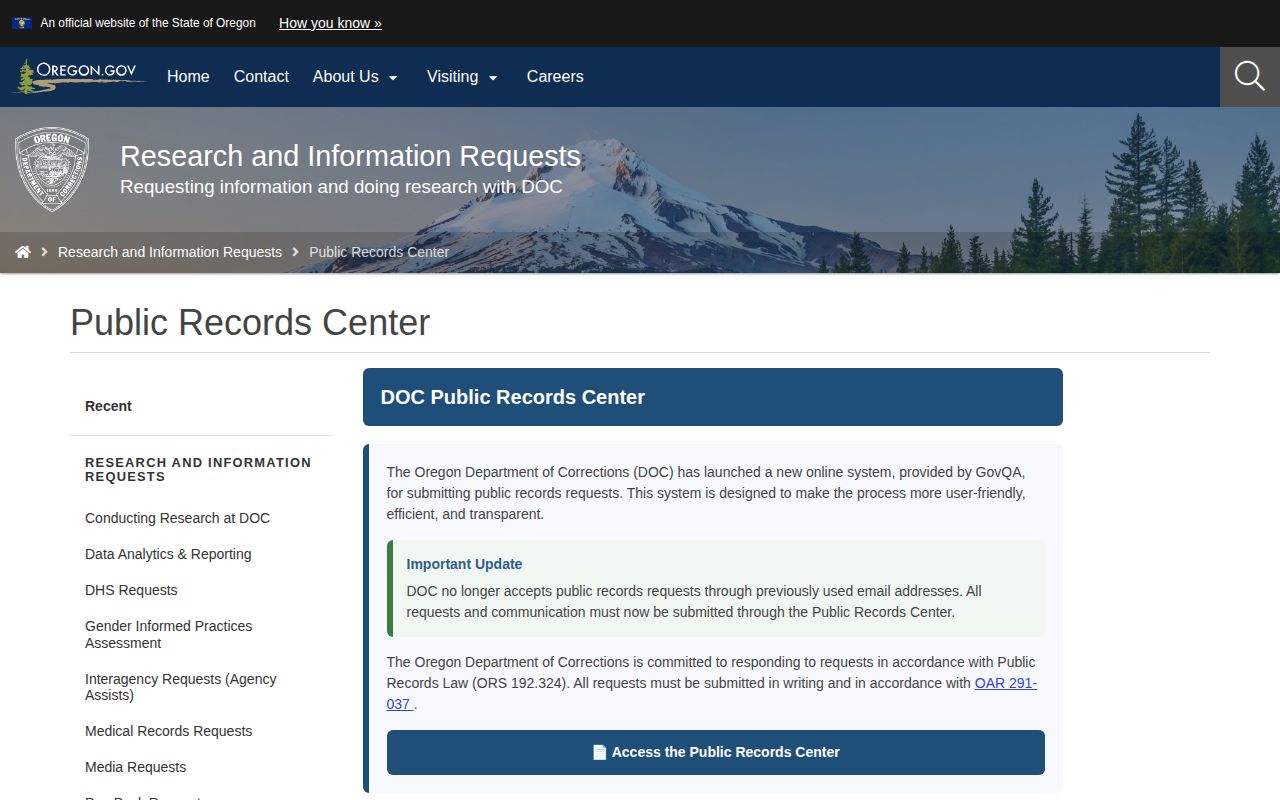
The captured page supports using the official records center when a public locator is not enough to prove a state release or discharge.
Confirm Multnomah Actual Release
Actual release should be confirmed through the agency that held the person. For MCSO, open the released booking detail and read Release Date and Release Reason. For ODOC, use the discharge entry or requested record. A judgment from the Multnomah Circuit Court records channel explains the legal sentence, but physical exit can occur later due to processing or another hold.
No verified Oregon or Multnomah rule was found that moves every Sunday or holiday release to Friday. Do not calculate such a shift. What MCSO does verify is that approval-to-exit processing may take four to five hours and that exact release times are unpredictable. A projected day therefore should not be converted into a pickup time.
For a pending custody change, Oregon VISOR can send a release or transfer notice. Current Oregon instructions use VISOR, not VINELink, and no legacy four-digit PIN. The Multnomah County VINELink Release Check explains the present VISOR workflow. Treat the alert as a prompt to confirm the MCSO or ODOC record.
A release reason is as important as the date. Time served, court order, transfer, and movement to another custody authority do not describe the same outcome. Compare the facility, booking event, case number, and charge status so an older or different booking is not mistaken for the event at issue. For multiple bookings, open the one tied to the relevant case and custody period.
Note: Physical release can follow approval by several hours, so confirm the exit before relying on a projected day or notice.